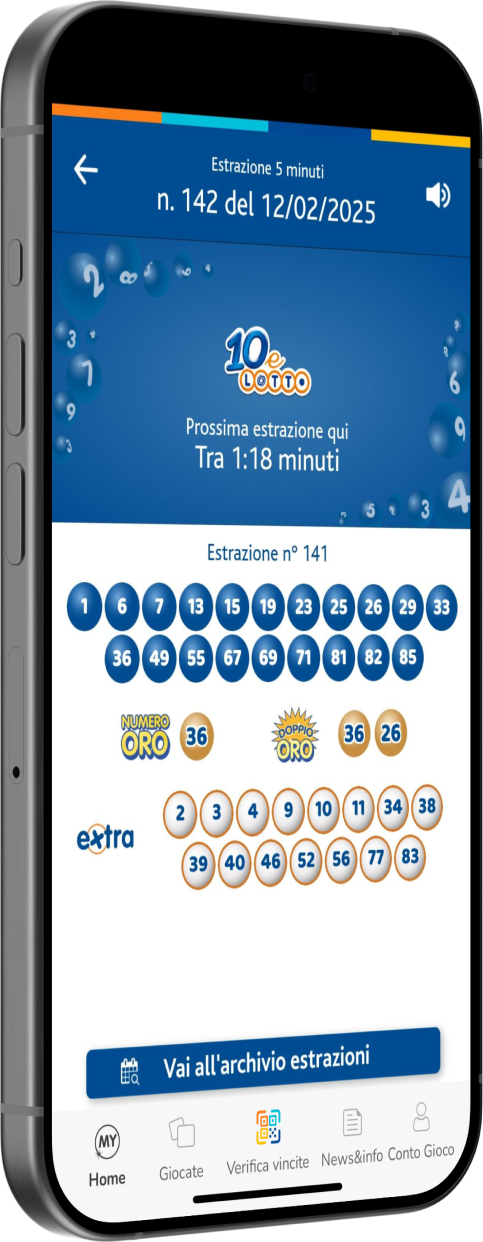
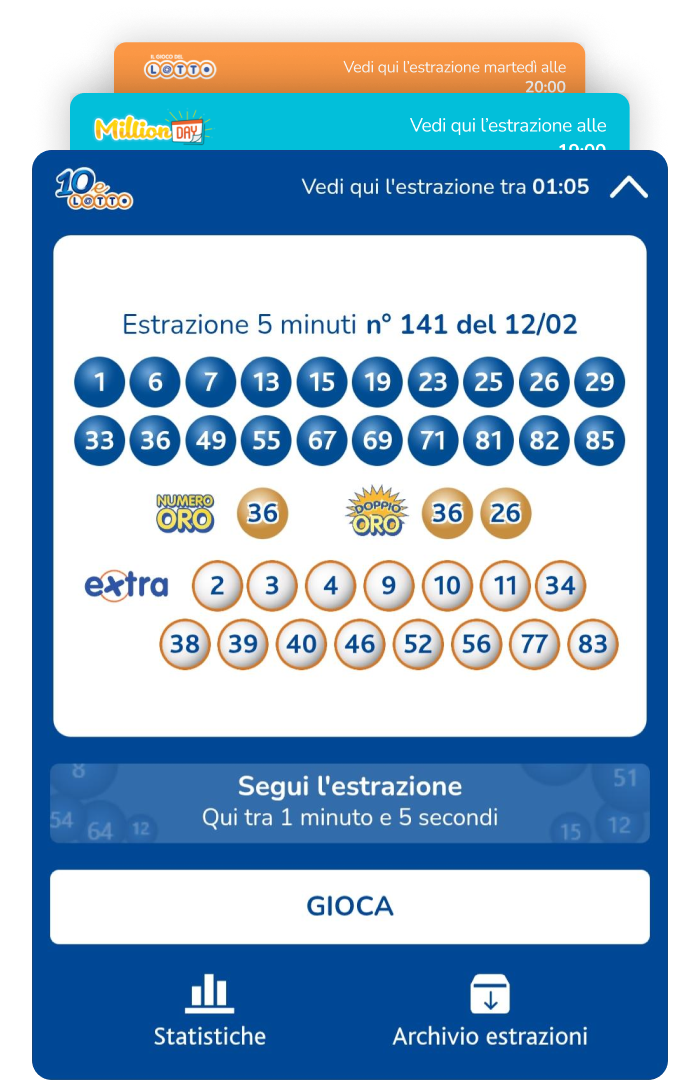
Con l’app ufficiale Lotto e Gratta e Vinci puoi verificare le
vincite, seguire le estrazioni in diretta e giocare on line
Scarica subito la nuova app!
Scarica subito la nuova app!
Inquadra il QR code oppure visita dal tuo smartphone il
sito
mylotteries.it
Inquadra il QR code con il tuo smartphone per aprire il sito
da mobile.
Inquadra il QR code con il tuo smartphone per aprire il sito
da mobile.
Come installare l'app
Come installare l'app
1Visita il sito
mylotteries.it
dal cellulare e premi il pulsante
SCARICA PER ANDROID
2Ti verrà chiesto di scaricare il file
MyLotteries.apk
premi il pulsante
SCARICA*
3Una volta scaricato il file premi il pulsante
APRI e infine
INSTALLA
*Se non hai mai scaricato un'app al di fuori del Play
Store vai su
IMPOSTAZIONI > SICUREZZA
del tuo smartphone e controlla che la voce
"Sorgenti sconosciute"
sia
ATTIVA
La tua esperienza di gioco in mobilità e in tutta sicurezza.
Con App My Lotteries puoi vivere la tua esperienza a
Lotto,
10eLotto,
MillionDay e
Gratta e Vinci
direttamente dal tuo smartphone dove e quando vuoi. Puoi
verificare se la tua giocata è vincente, compilare comodamente
la tua schedina in app e giocarla nel punto vendita, consultare
in qualsiasi momento gli ultimi numeri estratti nella sezione
archivio delle estrazioni e giocare online.
Con l’App My Lotteries puoi controllare se hai vinto semplicemente
inquadrando il biglietto Gratta e Vinci e lo scontrino del 10eLotto,
Lotto e MillionDAY nella sezione Verifica Vincite.
Japanese Mom Son Incest Movie Wi New May 2026
The true literary rupture came with the modernists, and no one is more pivotal than . In A Portrait of the Artist as a Young Man , Stephen Dedalus’s relationship with his mother, Mary, is a symphony of Catholic guilt, cloying love, and psychological warfare. She prays for his soul, weeps at his heresies, and represents the “old world” of Irish piety and paralysis that he must escape. Their most famous moment occurs off the page—in Ulysses , we learn that Stephen refused to kneel at his dying mother’s bedside. The ghost of that refusal haunts him through the novel. Here, Joyce draws the modern line: a son can love his mother and still be destroyed by her. To become an artist, he must commit a symbolic matricide—not of the body, but of the conscience she installed. Part II: The Cinematic Smothering – The 1950s and the Rise of the ‘Monstrous Mother’ If literature gave us the internal storm, cinema made it external, visceral, and loud. The 1950s in Hollywood is the golden age of the troubled mother-son relationship. This was the era of the “monstrous mother”—a figure who was overbearing, manipulative, and sexually possessive. She was a symptom of post-war anxiety: the powerful matriarch who had kept the home fires burning while men were at war, and who now refused to return to the kitchen.
Perhaps the most radical evolution is the recent move toward reconciliation and softness. (2018) offers a radical redefinition: the mother, Nobuyo, is not biological. She is a thief, a murderer of circumstance, and yet, her love for the young boy, Shota, is the most selfless in the film. When she whispers “I gave you my name,” it redefines motherhood as an act of will, not blood. The final scene, where Shota silently calls her “mom” from a moving bus, is a devastating testament to a bond that society condemns but biology cannot replicate.
The stories that last are not those where the son heroically escapes or the mother tragically sacrifices everything. They are the ones that acknowledge the knot cannot be untied—only loosened, tightened, or, with great effort, retied into a new shape. japanese mom son incest movie wi new
We are living in an era that craves nuance. The “monstrous mother” is being retired, replaced by the “impossible mother” and the “imperfect son.” Cinema and literature are finally asking the uncomfortable, beautiful question: What does it mean to love the person who made you, even when that making was a mess?
The archetype’s apotheosis is in Alfred Hitchcock’s Psycho (1960). Though dead for most of the film, her voice, her preserved corpse, and her normative cruelty are the engine of Norman Bates’s psychosis. “A boy’s best friend is his mother,” Norman says with a chilling smile. But this mother is a devourer. She has so thoroughly absorbed Norman’s psyche that he can no longer distinguish her will from his own. Psycho is the horror of symbiosis: the son not as an independent being, but as an extension of the mother’s jealous, puritanical id. The true literary rupture came with the modernists,
In literature, had already mapped this territory decades earlier. Sons and Lovers (1913) is the ur-text of the suffocating mother-son bond. Gertrude Morel, a refined, intelligent woman trapped in a marriage with a coarse miner, pours all her emotional and intellectual passion into her son, Paul. Lawrence’s prose is almost clinical in its dissection of how her love “cripples” Paul, making it impossible for him to have a complete relationship with any other woman. Miriam, the spiritual lover, and Clara, the physical one, both lose to the ghost of the mother. The novel’s final, devastating line—“She was the only thing he loved”—is not a tribute, but an epitaph.
In literature, (2019) is the new landmark. Written as a letter from a Vietnamese-American son, Little Dog, to his illiterate mother, Rose, the novel deconstructs everything we thought we knew. The mother is scarred by war, mentally ill, and physically abusive. Yet, the son’s voice is not one of accusation, but of profound, aching tenderness. Vuong writes: “I am writing because they told me to never start a sentence with ‘because.’ But I wasn’t trying to make a sentence. I was trying to break free.” The book is a masterpiece of reparation—a son using art to translate his mother’s trauma into a shared language of forgiveness, without demanding her to change. Conclusion: The Unbroken Thread What unites Sophocles’ Oedipus, Joyce’s Stephen, Hitchcock’s Norman, and Vuong’s Little Dog? It is not pathology, but influence . The mother-son relationship, in all its fraught variety, is the narrative engine of becoming. In literature, it is the interior monologue where a son negotiates his conscience. In cinema, it is the close-up on a son’s face as he watches his mother cry, or the wide shot of him walking away from her doorstep. Their most famous moment occurs off the page—in
Similarly, (2017) flips the script by centering the daughter-mother relationship, but its most interesting male character, Danny, has a fleeting but perfect moment with his own mother. It’s a brief scene of unconditional acceptance that underscores how rarely cinema shows healthy, stable mother-son bonds. For every one Danny, there are a dozen Norman Bateses.
The true literary rupture came with the modernists, and no one is more pivotal than . In A Portrait of the Artist as a Young Man , Stephen Dedalus’s relationship with his mother, Mary, is a symphony of Catholic guilt, cloying love, and psychological warfare. She prays for his soul, weeps at his heresies, and represents the “old world” of Irish piety and paralysis that he must escape. Their most famous moment occurs off the page—in Ulysses , we learn that Stephen refused to kneel at his dying mother’s bedside. The ghost of that refusal haunts him through the novel. Here, Joyce draws the modern line: a son can love his mother and still be destroyed by her. To become an artist, he must commit a symbolic matricide—not of the body, but of the conscience she installed. Part II: The Cinematic Smothering – The 1950s and the Rise of the ‘Monstrous Mother’ If literature gave us the internal storm, cinema made it external, visceral, and loud. The 1950s in Hollywood is the golden age of the troubled mother-son relationship. This was the era of the “monstrous mother”—a figure who was overbearing, manipulative, and sexually possessive. She was a symptom of post-war anxiety: the powerful matriarch who had kept the home fires burning while men were at war, and who now refused to return to the kitchen.
Perhaps the most radical evolution is the recent move toward reconciliation and softness. (2018) offers a radical redefinition: the mother, Nobuyo, is not biological. She is a thief, a murderer of circumstance, and yet, her love for the young boy, Shota, is the most selfless in the film. When she whispers “I gave you my name,” it redefines motherhood as an act of will, not blood. The final scene, where Shota silently calls her “mom” from a moving bus, is a devastating testament to a bond that society condemns but biology cannot replicate.
The stories that last are not those where the son heroically escapes or the mother tragically sacrifices everything. They are the ones that acknowledge the knot cannot be untied—only loosened, tightened, or, with great effort, retied into a new shape.
We are living in an era that craves nuance. The “monstrous mother” is being retired, replaced by the “impossible mother” and the “imperfect son.” Cinema and literature are finally asking the uncomfortable, beautiful question: What does it mean to love the person who made you, even when that making was a mess?
The archetype’s apotheosis is in Alfred Hitchcock’s Psycho (1960). Though dead for most of the film, her voice, her preserved corpse, and her normative cruelty are the engine of Norman Bates’s psychosis. “A boy’s best friend is his mother,” Norman says with a chilling smile. But this mother is a devourer. She has so thoroughly absorbed Norman’s psyche that he can no longer distinguish her will from his own. Psycho is the horror of symbiosis: the son not as an independent being, but as an extension of the mother’s jealous, puritanical id.
In literature, had already mapped this territory decades earlier. Sons and Lovers (1913) is the ur-text of the suffocating mother-son bond. Gertrude Morel, a refined, intelligent woman trapped in a marriage with a coarse miner, pours all her emotional and intellectual passion into her son, Paul. Lawrence’s prose is almost clinical in its dissection of how her love “cripples” Paul, making it impossible for him to have a complete relationship with any other woman. Miriam, the spiritual lover, and Clara, the physical one, both lose to the ghost of the mother. The novel’s final, devastating line—“She was the only thing he loved”—is not a tribute, but an epitaph.
In literature, (2019) is the new landmark. Written as a letter from a Vietnamese-American son, Little Dog, to his illiterate mother, Rose, the novel deconstructs everything we thought we knew. The mother is scarred by war, mentally ill, and physically abusive. Yet, the son’s voice is not one of accusation, but of profound, aching tenderness. Vuong writes: “I am writing because they told me to never start a sentence with ‘because.’ But I wasn’t trying to make a sentence. I was trying to break free.” The book is a masterpiece of reparation—a son using art to translate his mother’s trauma into a shared language of forgiveness, without demanding her to change. Conclusion: The Unbroken Thread What unites Sophocles’ Oedipus, Joyce’s Stephen, Hitchcock’s Norman, and Vuong’s Little Dog? It is not pathology, but influence . The mother-son relationship, in all its fraught variety, is the narrative engine of becoming. In literature, it is the interior monologue where a son negotiates his conscience. In cinema, it is the close-up on a son’s face as he watches his mother cry, or the wide shot of him walking away from her doorstep.
Similarly, (2017) flips the script by centering the daughter-mother relationship, but its most interesting male character, Danny, has a fleeting but perfect moment with his own mother. It’s a brief scene of unconditional acceptance that underscores how rarely cinema shows healthy, stable mother-son bonds. For every one Danny, there are a dozen Norman Bateses.